Seamless appearance
Continuous planes reduce visual interruption and conventional grout lines.
 818-383-2527
Designer finish · Microcement
A thin, continuous surface system for showers, bathrooms, floors, walls and architectural forms.
Request a Quote01 / A modern surface system
Microcement is a thin decorative coating system that creates the appearance of cast concrete across walls, floors, counters, fireplaces and wet areas. Applied in successive layers, it produces a continuous surface without conventional tile grout lines.
Most systems combine cementitious material, fine aggregate and polymer modifiers, then rely on primers, reinforcement where specified, and protective sealers. The finished build is only a few millimeters thick, making microcement particularly useful in renovations where added weight and floor height matter.
It can sometimes be installed over sound existing tile, concrete or plaster, but “over tile” never means “without preparation.” The assembly must be stable; joints must be treated; surfaces must be cleaned, abraded and primed; and wet areas still require a complete waterproof substrate beneath the decorative finish.
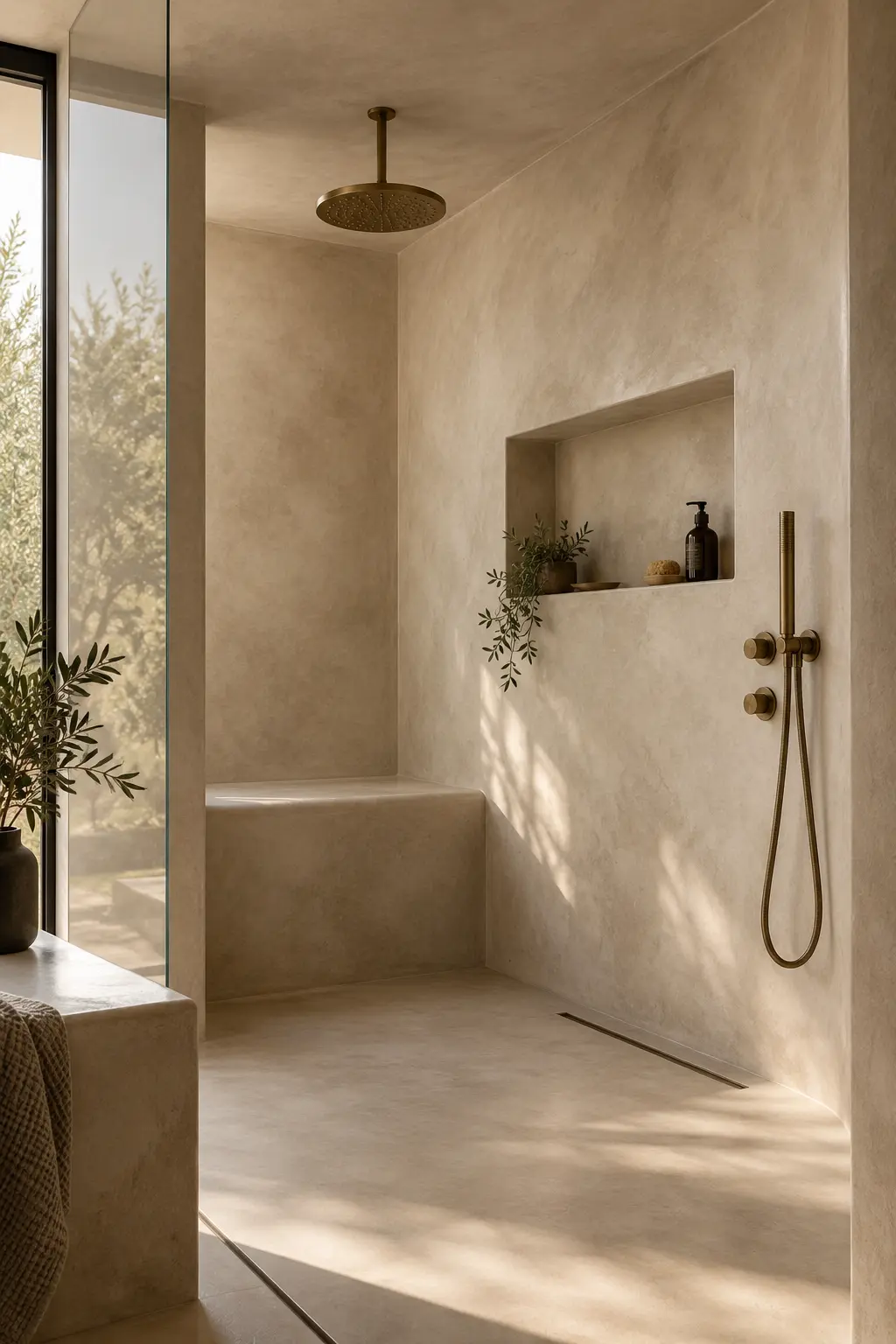
A continuous microcement finish removes visual grout lines while the waterproofing assembly does the work behind it.
02 / Microcement and tadelakt
Both finishes create continuous, tactile surfaces—but traditional tadelakt and modern microcement should not be presented as the same material.
Traditional tadelakt is an old-world Moroccan lime plaster associated with hammams, riads and water vessels. It is repeatedly compressed and treated with olive-oil soap. The soap reacts with the lime to form water-resistant calcium soaps within the surface. It is mineral, highly artisanal and dependent on skilled execution and a compatible substrate.
Microcement is the modern, more predictable and often more affordable route to a similar seamless idea. Its water and stain resistance generally comes from a contemporary multi-layer system and epoxy, polyurethane or other manufacturer-specified sealers—not from the natural soap reaction used in tadelakt.
Both have a place. Tadelakt offers extraordinary organic character and historic craft; microcement offers broader substrate compatibility, controlled performance and practical remodeling advantages.
03 / Why microcement
Continuous planes reduce visual interruption and conventional grout lines.
Approved systems can go over stable tile, limiting demolition and debris.
A few millimeters of finish preserve transitions and existing geometry.
Complete systems can perform in showers and bathrooms when correctly detailed.
Color, movement, texture and sheen can shift from warm stone to modern concrete.
Compatible assemblies can cover tile, plaster, masonry, concrete and prepared board.
04 / Our process
Microcement succeeds or fails beneath the surface. We review movement, waterproofing, joints, drainage and product compatibility before decorative work begins.
We inspect tile, board, concrete, joints, moisture conditions, slope, drains and penetrations.
Color, texture, slip requirements and sealer sheen are approved for the intended use.
Surfaces are cleaned, repaired, abraded and primed; mesh or joint treatment is installed where the manufacturer requires it.
Successive cementitious layers build a flat, continuous surface with controlled movement.
The approved protective system is applied in full and allowed to cure before water exposure or heavy use.
05 / Applications
Microcement can connect multiple surfaces while preserving the architecture underneath.
Walls, benches, niches and selected floors can read as one quiet, grout-free composition.
Thin build and concrete character suit renovations, with slip and wear requirements specified in advance.
Backsplashes, islands and architectural counters gain continuity, subject to use-specific sealing.
Microcement can give feature forms a monolithic mineral presence without a structural pour.
06 / Remodel value
When existing tile or concrete is sound and the selected manufacturer approves the assembly, microcement can be installed over it. That may avoid demolition, hauling, dust, noise and reconstruction of otherwise serviceable surfaces.
This does not eliminate preparation or waterproofing. It shifts the investment from removal and replacement toward reinforcement, leveling, finish work and protection.
Because every remodel differs, we confirm adhesion, movement, elevations, drains, door clearances and transitions before recommending an overlay.
07 / Durability and care
Substrate condition, tile joints, waterproofing, reinforcement, geometry, drains, access, area and sealer system all shape the proposal.
Use mild, pH-appropriate cleaners and non-abrasive tools. Harsh chemicals can damage the protective sealer.
High-use and wet surfaces require periodic inspection and eventual resealing. Timing depends on system, use and cleaning practices.
Like wood, stone and other premium surfaces, it can show wear. Use protective pads and avoid dragging sharp or heavy objects.
08 / Common questions
Often, yes—if the tile is sound and the manufacturer approves the assembly. Cleaning, abrasion, joint treatment, leveling and primer remain essential.
The finished system can be water-resistant, but showers rely on a separate waterproof assembly beneath it plus properly maintained sealers.
No. Polished concrete is a structural slab; microcement is a thin applied coating that creates a similar visual language.
It is often the more accessible and predictable option because products and sealers are standardized, but project geometry and preparation still control cost.
Only with a product system specifically approved for the climate, substrate and exposure. Freeze-thaw, UV and drainage conditions must be considered.
Cure time is product-specific. We follow the full manufacturer schedule before water exposure.
09 / Further reading
Supporting Journal guides will connect here as they are published.
Start with the assembly
Tell us what exists now, where water will be present and how the surface must perform. We’ll recommend the right system.
Request a Quote