Velvety matte depth
A soft, suede-like wall with controlled tonal movement.
 818-383-2527
Designer finish · Roman Clay
A hand-troweled matte finish with the quiet depth of stone and the warmth of an artisan surface.
Request a Quote01 / A modern troweled finish
Roman Clay is a thin, hand-applied decorative finish that produces a velvety, stone-like wall with subtle tonal movement. It sits between limewash and polished Venetian plaster: quieter than a brushed mineral wash, softer and more matte than a highly burnished plaster.
The name describes a family of contemporary products rather than one universal historic formula. Depending on the manufacturer, the material may contain clay, mineral binders, gypsum, lime or proprietary resins. We specify the complete system—primer, decorative coats and optional sealer—according to the chosen product and the room’s performance requirements.
“Moroccan Clay” is sometimes used as a product or marketing name for a similar matte troweled aesthetic. It should not be confused with traditional Moroccan tadelakt, a lime plaster polished with soap for wet-area use.
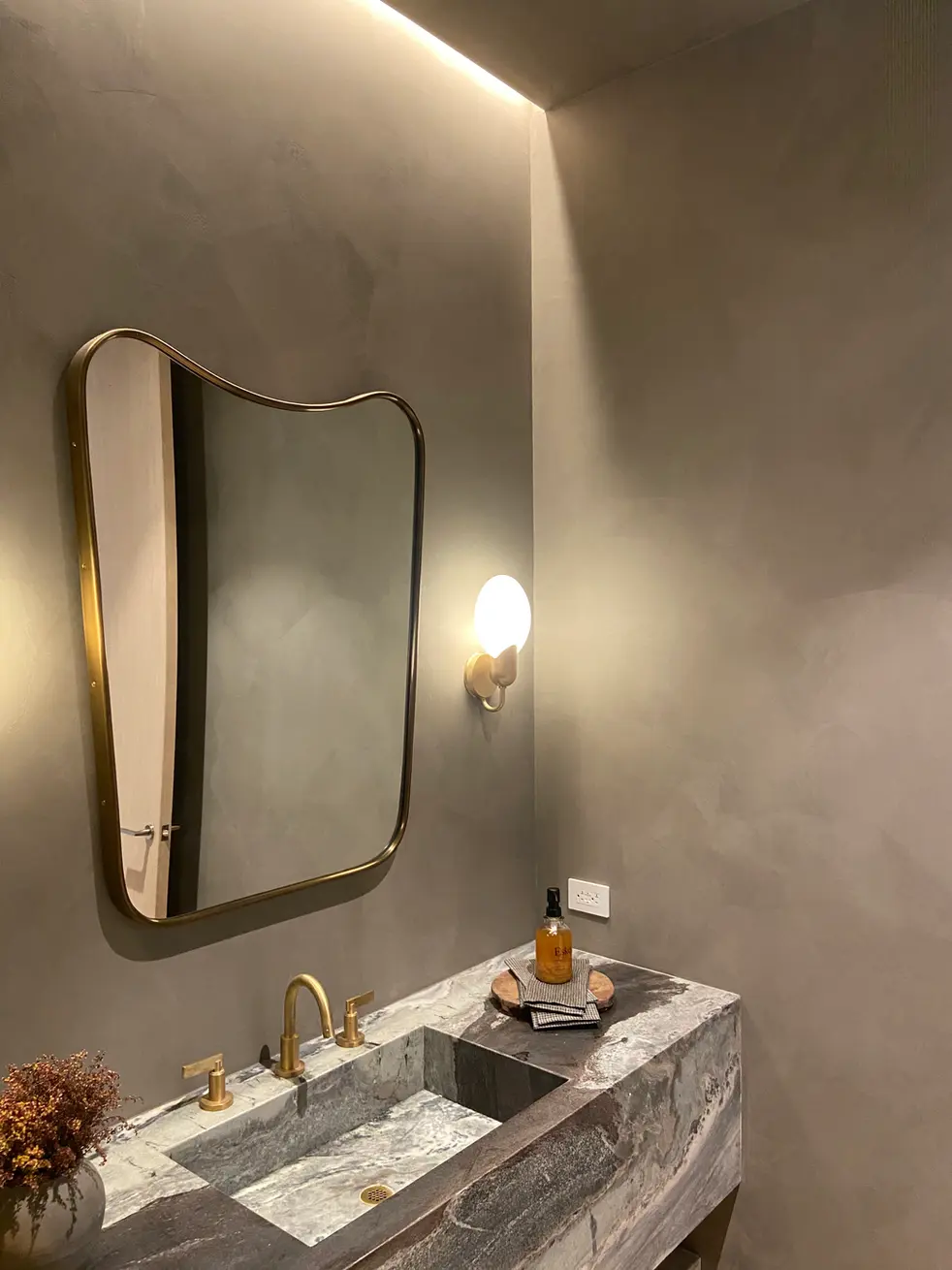
Thin overlapping passes build depth without creating a repeated or mechanical pattern.
02 / Material character
The beauty of Roman Clay comes from compression, variation and the trace of the applicator’s hand—not from heavy texture.
Light moves across the surface differently throughout the day. Broad walls may read as calm and nearly monolithic from a distance, then reveal fine overlapping trowel marks as you approach. Color, substrate smoothness, tool choice and degree of sanding all influence the final appearance.
Light colors demand especially controlled preparation and clean tools. We often use non-marking or plastic trowels where metal burnishing could create dark marks. Every finish is approved on a representative sample before production begins.
03 / Why designers choose it
A soft, suede-like wall with controlled tonal movement.
Architectural presence without the visual weight of masonry.
Each plane carries subtle evidence of the artisan’s application.
Works in chalky whites, warm neutrals, mineral earths and saturated tones.
Can remain softly mottled or be sanded and compressed for greater polish.
Pairs naturally with wood, stone, linen, brass and clean millwork.
04 / Our process
Roman Clay does not hide unevenness. A beautiful result begins with a stable, properly leveled substrate and a clearly approved visual standard.
We inspect drywall level, repairs, texture, coatings, corners and movement. Heavy texture generally requires skim coating.
Color, movement, trowel size, sanding and sealer are reviewed in representative lighting.
Surfaces are repaired, leveled, sanded and primed with the manufacturer-specified ground.
Two or more thin passes are applied in overlapping strokes, beginning from a controlled dry edge.
The finish may be lightly sanded or compressed, then left natural or sealed after sample approval.
05 / Applications
Roman Clay works best where the architecture benefits from softness, depth and continuity.
Broad planes become calm backdrops with more life than uniform paint.
Matte movement creates an enveloping atmosphere without reflective glare.
A stone-like finish can unify sculptural forms when substrate and heat conditions are appropriate.
Small architectural moments can carry deeper color and expressive movement.
06 / Choosing the right finish
Roman Clay is trowel-applied, matte and generally smooth, with a dense stone-like presence.
Limewash is brushed and typically more atmospheric, translucent and visibly varied.
Venetian plaster is built in multiple lime-and-marble layers and can be honed or polished to greater luminosity.
The correct choice depends on substrate, light, movement, touch, durability and budget—not simply a photograph.
Compare with Limewash07 / Cost, durability and care
Wall condition, skim coating, height, access, number of colors, edges, sample complexity and protection all affect the proposal.
On a stable wall it performs well for normal interior use. Unsealed matte finishes remain more sensitive to rubbing, oils and aggressive cleaning.
A compatible matte sealer adds wipeability but may deepen color or change sheen. We approve that change on the sample.
Dust gently and use mild cleaning only where permitted. Refreshing the full plane often gives the best repair result.
08 / Common questions
Yes, when the coating is sound and the wall is repaired, leveled and primed with the specified system.
A very smooth substrate is ideal. Existing walls can often be skimmed and sanded to create it.
It suits powder rooms and selected low-splash walls. It is not automatically a waterproof shower finish.
No. Tadelakt is a traditional lime plaster polished with soap; Roman Clay is a contemporary decorative coating.
Sealed systems can generally be wiped gently. Limits depend on the manufacturer and sealer.
No. The approved sample establishes direction and movement, but hand-applied variation remains part of the finish.
09 / Further reading
Supporting Journal guides will connect here as they are published.
Begin with a sample
Tell us about the wall, lighting and atmosphere you want to create. We’ll help determine whether Roman Clay is right.
Request a Quote