
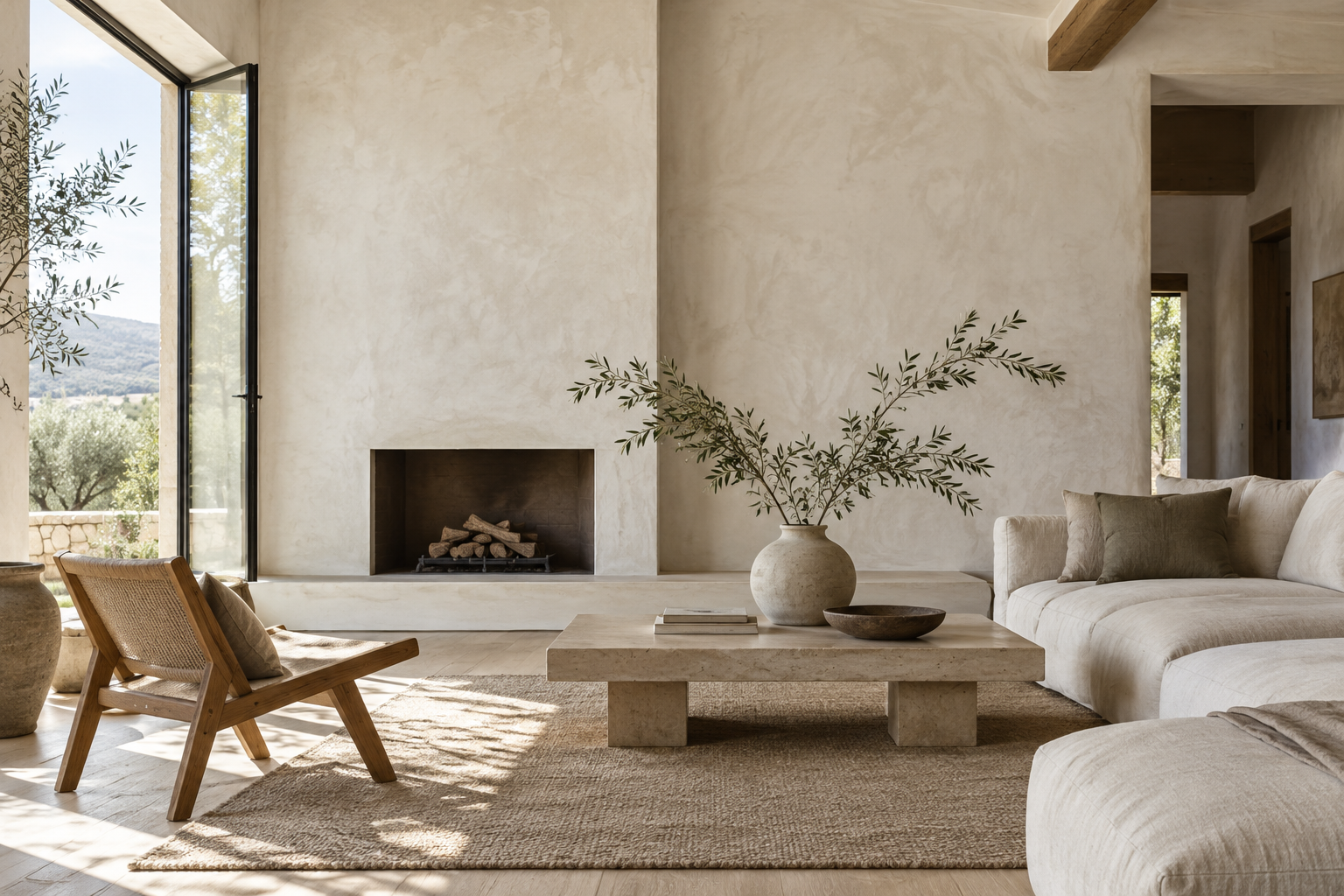
A beautiful wall does more than carry color. It changes with daylight, softens the architecture around it and contributes to the way a room feels. Limewash brings that quality through a mineral surface that is naturally matte, vapor permeable and rich with subtle variation.
Its breathability is often described as a wellness benefit, but the most accurate story begins with building science: limewash can allow water vapor to pass through compatible wall assemblies instead of trapping it behind a dense coating.
What does “breathable” mean in a wall finish?
In this context, breathable does not mean that a wall inhales like a living organism. It means the coating is vapor permeable. Water vapor can move through the finish, which helps a properly designed mineral wall dry rather than remain sealed beneath an impermeable film.
That distinction matters most on porous substrates such as lime plaster, masonry and certain cementitious surfaces. A finish should work with the wall assembly beneath it. Limewash is especially well suited to mineral backgrounds because it forms a mineral bond and remains open to vapor movement.
Why moisture movement matters
Moisture enters buildings in many ways: normal indoor humidity, weather exposure, plumbing problems and movement through masonry. No decorative finish can correct a leak, inadequate ventilation or a poorly detailed envelope. But on a sound, properly prepared mineral wall, a vapor-open coating can support drying and reduce the risk created by trapping moisture.
This is one reason lime-based finishes have remained important in historic preservation. Traditional masonry was designed to manage moisture differently from many modern framed assemblies, and dense coatings can sometimes disrupt that balance.
Limewash compared with conventional paint
Many conventional acrylic paints form a continuous film over the surface. Those products can be excellent choices where washability, stain resistance or a very uniform appearance is the priority. Limewash behaves differently. It penetrates and bonds with a compatible mineral substrate, producing a matte, softly variegated finish rather than a plastic-like surface film.
Neither category is universally “better.” The right coating depends on the substrate, exposure and performance requirements. Limewash earns its place when mineral character, vapor permeability and tonal depth are central to the design.
Health and environmental considerations
Traditional limewash has a short ingredient list and many mineral systems are formulated with very low or no added volatile organic compounds. Product formulas vary, so specifications and safety data should always be reviewed rather than assuming every limewash is identical.
As lime cures, it carbonates—reacting with carbon dioxide as it returns toward calcium carbonate. This does reabsorb a portion of the carbon dioxide associated with lime production, but it should not be confused with proof that every limewash product or project is carbon negative.
Lime's alkalinity can also make the fresh surface less hospitable to some microorganisms. That does not make limewash a substitute for moisture control, ventilation or professional remediation. A healthy interior still depends on the entire building system.
Breathability as beauty
The technical performance of limewash is only half the attraction. Because thin coats interact with the substrate and with one another, the finished wall holds a range of related tones. Morning light may reveal one movement; evening light reveals another. Edges, brushwork and absorption create a surface that feels quiet but never flat.
That natural variation is why limewash pairs so well with stone, linen, wood, plaster and handmade objects. It gives clean contemporary architecture a sense of age and material presence without relying on ornament.
Where limewash works best
Limewash performs most naturally on porous mineral surfaces. Existing painted drywall may require a manufacturer-approved mineral primer or a specifically designed modern limewash system. Exterior applications require careful evaluation of climate, exposure and substrate.
In bathrooms, limewash may be appropriate on walls outside direct splash zones when ventilation and preparation are right. It is not a waterproofing system for showers. Where continuous water resistance is needed, materials such as tadelakt or sealed microcement may be more appropriate when correctly specified and installed.
Common misconceptions about limewash
“Limewash is maintenance free.”
No architectural finish is maintenance free. Limewash ages gracefully and can often be refreshed without stripping the entire surface, but high-touch areas and exterior elevations may need periodic renewal.
“Limewash never peels.”
A mineral bond can be extremely durable on a compatible surface. Poor preparation, an incompatible substrate or moisture problems can still cause failure.
“Every limewash is completely natural.”
Traditional formulas can be very simple, while modern products vary. Ask what is in the specified system and choose it based on both design and performance.
Long-term value for the home
Limewash offers value through character and renewability. Its surface is meant to develop a patina, so normal aging can feel integrated rather than immediately defective. When a refresh is desired, additional compatible coats can restore color while preserving depth.
For the best result, bring the finish team into the project early. Substrate decisions, primer selection, sample approval, trade sequencing and protection all affect the final wall.
Explore our complete limewash guide, or read the history of limewash from antiquity to modern design.
Bring mineral depth into your space
We create considered limewash finishes for homes and design-led spaces, with attention to preparation, color, light and the architecture of the room.