
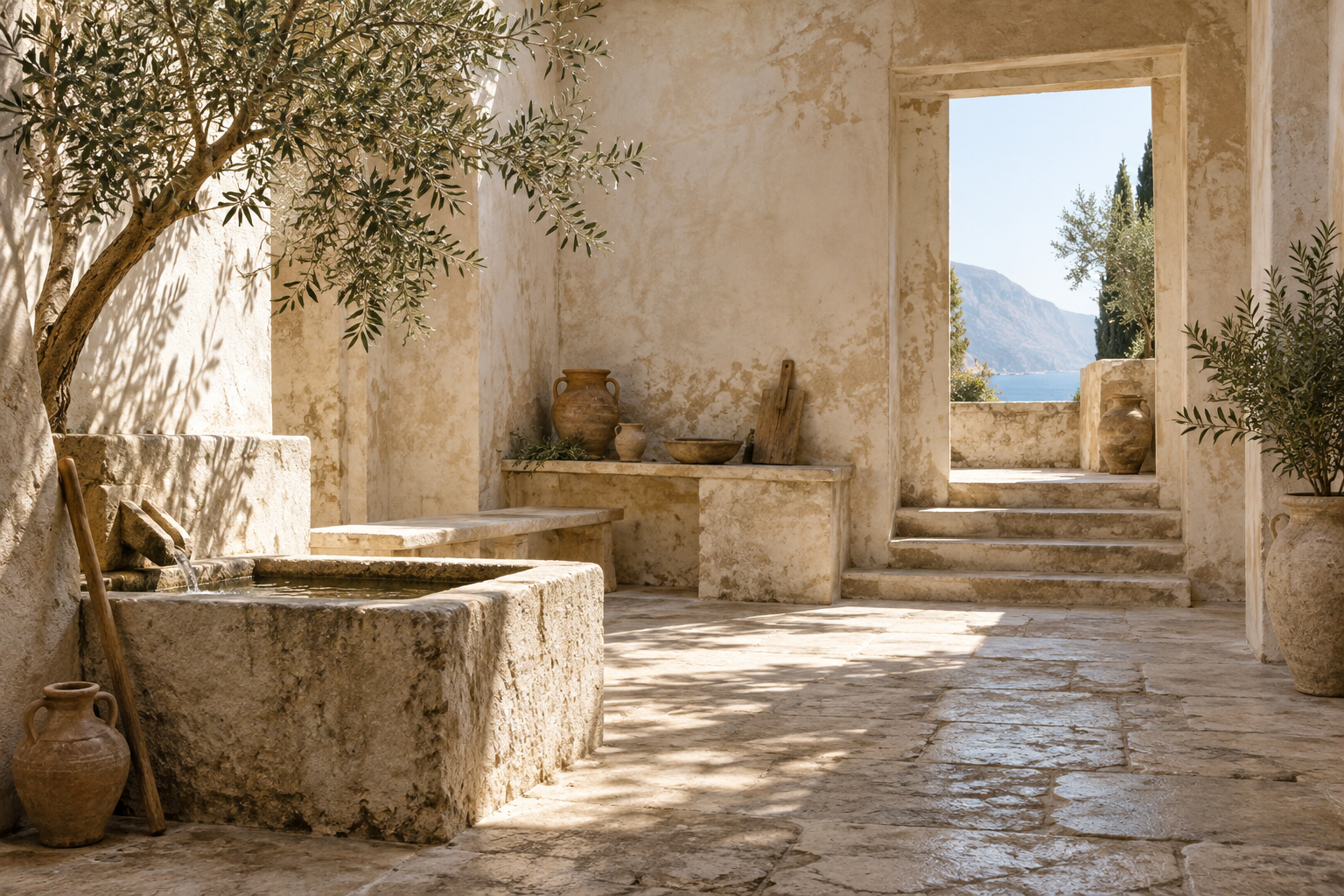
Limewash has moved through centuries of architecture without losing the qualities that first made it useful: a mineral surface, a soft relationship with light and a finish that feels inseparable from the wall beneath it. Long before it returned to contemporary interiors, lime was part of the practical language of building across the Mediterranean, Europe and the Americas.
What is limewash?
Limewash is a thin mineral coating traditionally made from mature lime putty and water, sometimes with mineral pigments. Applied in multiple translucent coats, it bonds best with porous mineral surfaces such as lime plaster, masonry and stone. Instead of creating a uniform film, it develops gentle tonal movement as the surface absorbs the material at different rates.
That variation is not a flaw. It is the visual signature that gives limewashed walls their quiet depth.
Ancient roots in the Mediterranean
Lime-based finishes reach back thousands of years. Builders in ancient Egypt, Greece and Rome used burned limestone in mortars, plasters and protective coatings. Roman writers, including Vitruvius, documented the preparation of lime and the careful construction of plaster surfaces—evidence of a sophisticated mineral-building tradition rather than a primitive substitute for paint.
Across Roman interiors and public buildings, lime plaster and pigmented finishes provided both a finished surface and a ground for decoration. The chemistry remains remarkably simple: limestone is heated to create quicklime, carefully slaked with water and matured into lime putty. When applied and exposed to air, the lime carbonates, gradually returning toward limestone.
From cottages to churches and civic buildings
Through medieval and early-modern Europe, limewash became a familiar finish on cottages, farm buildings, churches and masonry walls. It was accessible, compatible with traditional construction and easy to renew. On vernacular buildings, repeated coats created layered surfaces whose color and texture changed gently over time.
Limewash also served a practical role. Because it remains vapor permeable, it works with walls built from lime mortar, brick and stone rather than sealing them beneath a dense synthetic film. That compatibility is one reason conservation specialists continue to specify lime finishes for historic structures.
Limewash in early American architecture
European lime traditions crossed the Atlantic and became part of early American building practice. Lime-based washes appeared on masonry, farm structures and interiors where local materials and straightforward maintenance mattered. Regional recipes varied according to available limestone, pigments and craft knowledge.
Historic limewash was often renewed as part of a building's care. Each application added another translucent layer, producing the soft patina that contemporary designers now value.
How limewash is made
The traditional process begins with limestone. After firing, the resulting quicklime is slaked with water to make lime putty. That putty may be matured, diluted and tinted with mineral pigments before application. The finish is brushed on in thin coats, and the surface, temperature, moisture and technique all influence the final movement.
Modern products may include carefully selected additives to improve consistency or suit particular substrates, so not every commercial limewash is identical. The important distinction is whether the system remains mineral, vapor permeable and appropriate for the surface beneath it.
Why limewash declined—and why it returned
Industrial paint offered speed, standardized color and easy retail distribution. As acrylic and latex coatings became dominant, many traditional mineral finishes receded from everyday construction. Their revival reflects a broader change in design: homeowners, architects and designers are again looking for natural materials, subtle variation and rooms that feel made rather than manufactured.
Limewash fits that desire without becoming nostalgic. In a contemporary home, it can soften precise architecture, connect plaster walls to stone and wood, and give changing daylight something to reveal.
A historic finish for modern rooms
The history of limewash matters because it explains how the material behaves. This is a finish developed in conversation with mineral walls, hand application and time. When the substrate is prepared correctly and the color is considered in the room itself, limewash can feel both ancient and entirely current.
Explore our limewash services and complete finish guide, or continue with why breathable mineral walls matter.
Considering limewash for your home?
The best results begin with the substrate, the light and the desired degree of movement. We help homeowners, designers and builders choose the right system and plan the preparation before finish work begins.