
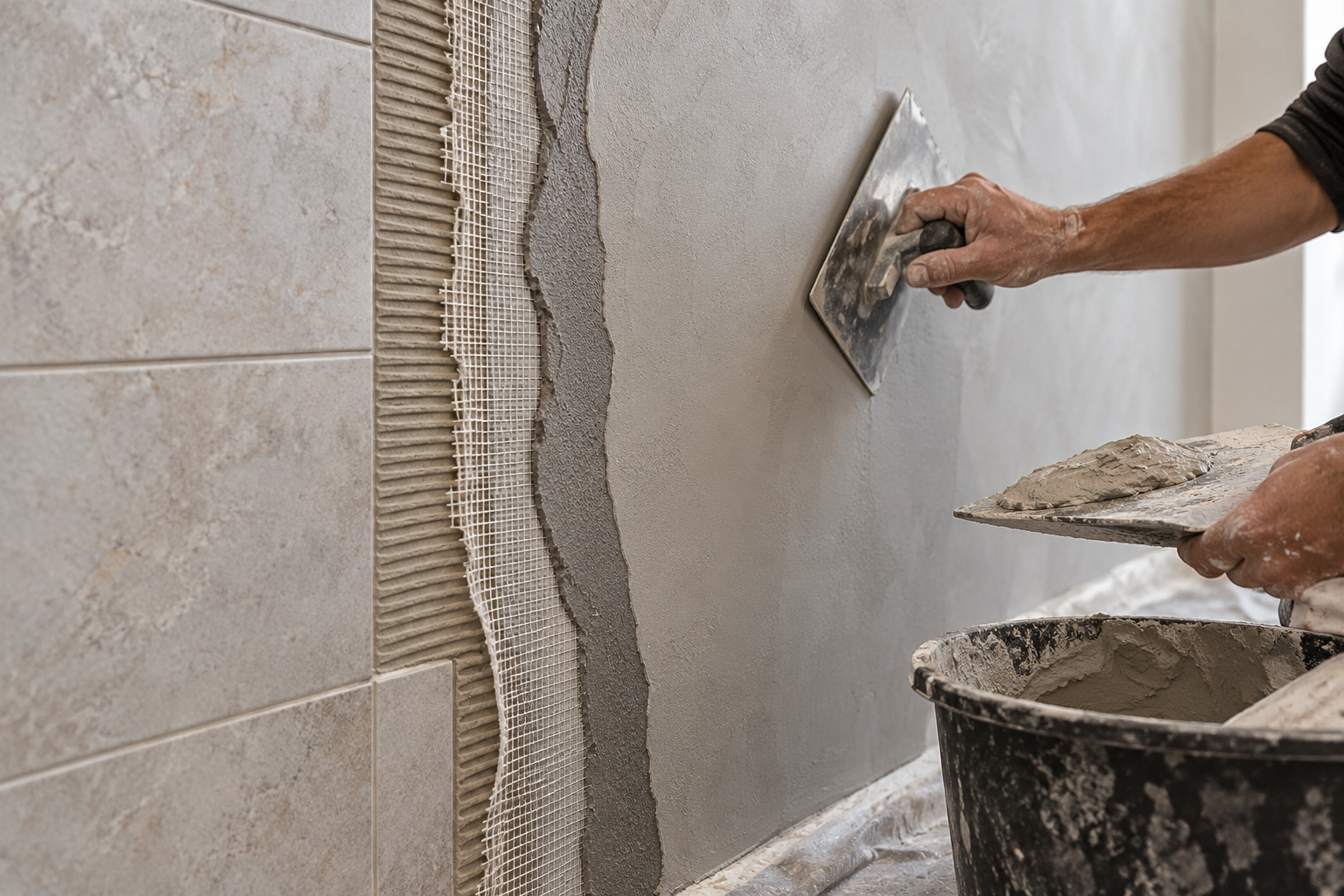
One of microcement’s most appealing renovation possibilities is the ability to create a continuous surface without automatically demolishing every existing tile. In the right conditions, a manufacturer-approved microcement system can be installed over well-bonded tile. That does not mean every tiled wall or floor is a candidate. Covering a defective assembly only conceals the evidence; it does not correct the failure.
Start with the bond
Every tile plane should be inspected for hollow, loose or cracked areas. Isolated defects may be repairable, but widespread hollow sound, movement or debonding usually points toward removal. The new finish will only be as secure as the old tile’s bond to its substrate.
Movement matters as much as adhesion. Flexible floors, poorly supported walls and active structural cracks can telegraph through a thin decorative system. Changes of plane and control joints require intentional detailing rather than being buried and forgotten.
Grout lines must disappear structurally, not just visually
Microcement is thin. If deep grout joints are simply skimmed with finish material, the grid can reappear as the system dries or moves. Professional preparation normally includes cleaning, abrasion or bonding treatment, filling and leveling joints, and applying compatible reinforced base layers. The goal is to create one uniform receiving surface before the decorative coats begin.
Highly glazed tile also needs a verified bond strategy. That may involve mechanical abrasion and a specialized primer. Product compatibility is essential; a random bonding primer, patch compound and decorative finish from unrelated manufacturers is not a tested system.
What covering tile does not solve
Microcement over tile does not repair failed waterproofing behind a shower. If there is moisture intrusion, damaged board, mold, poor drain detailing or missing slope, the responsible solution is to open the assembly and rebuild it. The absence of visible leakage is not proof that a wet-area system is sound.
Likewise, covering tile does not change poor geometry. Crooked corners, uneven planes, inadequate floor pitch and badly aligned niches remain present unless corrected during preparation.
Height, clearances and transitions
Even a thin system adds thickness. Door clearances, drains, thresholds, plumbing trim, glass channels and adjacent flooring should be checked before proceeding. A seamless look is only successful when the edges are resolved cleanly.
On floors, the installer also considers slip resistance and wear. A polished sample that looks beautiful on a wall may be inappropriate under wet feet. Texture and sealer must match the location.
When installation over tile makes sense
It is most attractive when the existing tile is flat, firmly bonded and dry; the assembly is known to be waterproof where required; movement is controlled; and avoiding demolition protects adjacent work or shortens the renovation. Removal is safer when the tile is failing, the wet-area assembly is questionable, elevations cannot tolerate added thickness or the substrate needs major correction.
The correct decision is made after inspection, not from a promise that microcement goes over anything. Read our microcement shower waterproofing guide and microcement cost guide, or explore the complete finish page.