
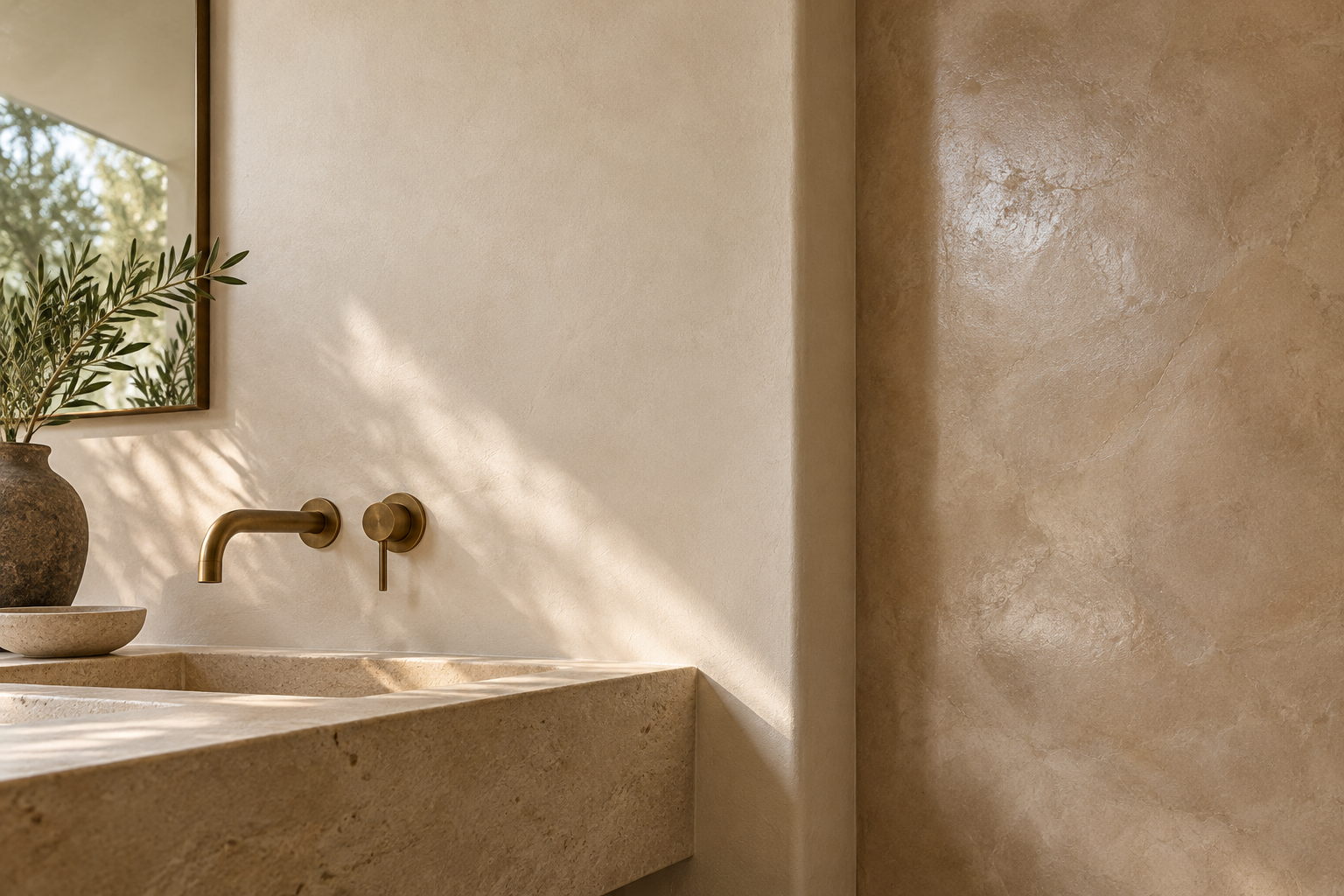
Microcement and tadelakt are often placed in the same category because both can create continuous, grout-free surfaces. Visually, either can produce a quiet mineral room with softened corners and uninterrupted planes. Technically, however, they are very different systems. Understanding that difference matters most in bathrooms and showers, where appearance cannot be separated from waterproofing, substrate movement and maintenance.
What is traditional tadelakt?
Tadelakt is an old-world Moroccan lime plaster. It is applied in layers, compressed with a polishing stone and traditionally treated with olive-oil black soap. The soap reacts with the lime to form water-resistant calcium soaps within the surface. Proper tadelakt is therefore not simply a textured coating with a clear sealer placed over it. Its character comes from lime, compression, soap and the hand of the artisan.
The result is softly luminous rather than perfectly uniform. Rounded transitions and subtle tool movement are part of its identity. Because the material and technique are demanding, tadelakt is normally chosen for projects where authenticity, natural composition and craft are central priorities.
What is microcement?
Microcement is the modern, generally more affordable route to a related seamless aesthetic. It is a thin cementitious decorative system modified with polymers or resins. A complete installation commonly includes primer, reinforcement where required, base coats, finish coats and a compatible sealer. In wet areas, the decorative finish belongs over a correctly built waterproof assembly; the finish itself should not be asked to replace the shower membrane.
Microcement can move from walls to floors, vanities, benches and other forms with very little visual interruption. It offers a broad color range and can be refined from softly mottled to more concrete-like. The final sealer usually provides the practical stain and water resistance.
Waterproofing is achieved differently
Traditional tadelakt develops water resistance through lime chemistry, compression and soap. Microcement usually relies on a modern assembly: stable substrate, waterproofing where required, reinforced decorative coats and a film-forming sealer. That makes microcement familiar to contemporary construction teams, but it also means that detailing at drains, niches, penetrations and changes of plane must be planned before finish work begins.
Neither finish should be selected from a photograph alone. The installer must know what sits behind the surface, which product system is being used and what maintenance the owner will accept.
Appearance, maintenance and cost
Tadelakt tends to feel softer, more organic and more historically grounded. Microcement can be quieter and more controlled, with a wider range of contemporary colors and textures. Tadelakt is maintained with appropriate soap and gentle care. Microcement depends on the condition of its sealer and may require periodic resealing in hard-use or frequently wet areas.
Microcement is usually the more accessible option because the material system is designed for modern substrates and application workflows. Tadelakt carries a premium for specialist labor, multiple hand-compressed stages and the small number of artisans who execute it correctly. Both have a legitimate place: microcement for durable contemporary continuity, and tadelakt for clients who value natural lime chemistry and unmistakable Moroccan craft.
How we choose
We begin with water exposure, substrate, transitions, cleaning expectations and the desired degree of movement. For a modern shower with linear details and predictable maintenance, microcement is often the practical answer. For a softly sculpted room where natural lime and hand-polished variation are the point, tadelakt may be worth the additional investment.
Continue with our guide to microcement shower waterproofing, or explore the complete Microcement pillar page.