
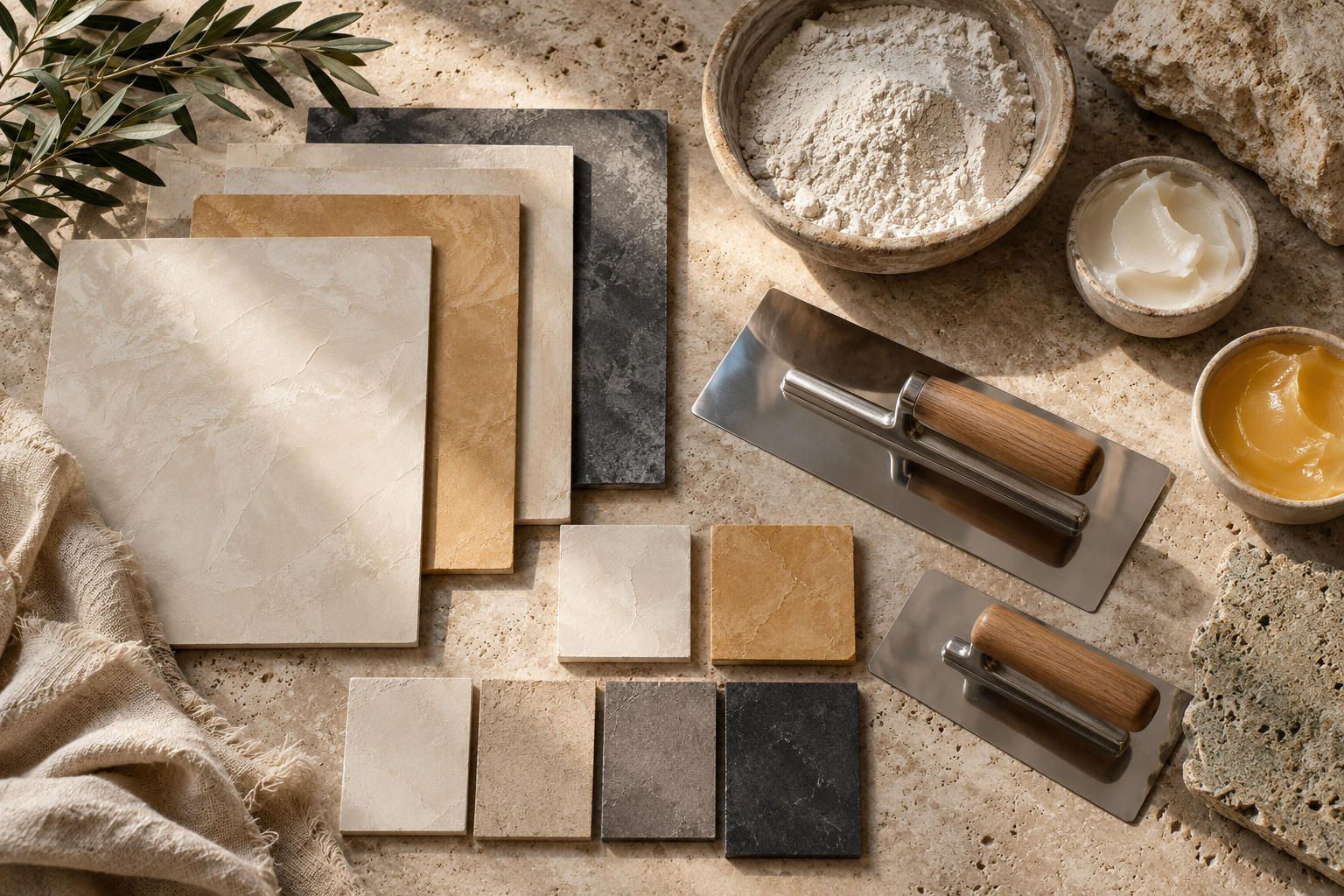
Professional Venetian plaster is not priced like ordinary wall paint. The material is applied by hand in multiple thin layers, and the final appearance depends on preparation, trowel pressure, timing, sanding, compression and sometimes wax or another protective treatment. A price per square foot can help establish a budget, but the finish level and wall condition determine whether that number is meaningful.
A realistic planning range
For artisan-installed Venetian plaster, a broad planning range is commonly about $15 to $30 per square foot. Highly polished work, dark colors, difficult access, curved architecture and small detail-heavy areas can exceed that range. Softer matte Marmorino on large open walls may fall nearer the lower end, while complex polished plaster belongs toward the upper end.
Small features also carry project minimums. A fireplace may contain relatively little square footage but still requires protection, mobilization, samples, edge work, several application visits and careful sequencing.
Preparation changes the price
Polished finishes magnify defects. Existing texture may need skim coating; repairs must be feathered broadly; corners and reveals must be crisp; and cracks require evaluation. A wall that appears acceptable for flat paint may not be ready for reflective plaster. If the proposal assumes a finish-ready substrate, that assumption should be written clearly.
New drywall quality matters as well. The plaster trade should review joints, fastener telegraphing, sanding marks and transitions before primer. Correcting those conditions after decorative coats begin is more expensive and less reliable.
Finish level and number of layers
A softly honed Marmorino and a glass-like polished plaster may use related materials but require different labor. More layers, finer sanding and greater compression increase time. Dark saturated colors can show lap marks or tool variation more readily and may demand smaller working sections or additional refinement.
The approved sample should include the exact color, application movement, sheen and protective treatment. An unsealed sample is not sufficient if the production surface will be waxed or sealed, because protection can deepen color and alter reflection.
Access, edges and interruptions
High walls, stairwells, scaffolding, tight powder rooms and rooms filled with finished millwork slow production. So do niches, returns, beams, integrated shelving and numerous openings. Broad uninterrupted walls usually offer better square-foot efficiency than a smaller surface with many edges.
What a complete proposal should state
Look for defined substrate preparation, primer, product family, number of coats, sample allowance, expected sheen, wax or sealer, protection, access equipment and repair expectations. Clarify whether adjacent painting, electrical fixture removal, fireplace heat preparation or construction correction is included.
Venetian plaster is expensive because the visible surface records every decision beneath it. The value is not simply material on a wall, but a controlled sequence that turns a plane into luminous architecture.
Continue with preparation and application, compare Venetian plaster, Marmorino and Roman Clay, or visit our complete finish guide.