
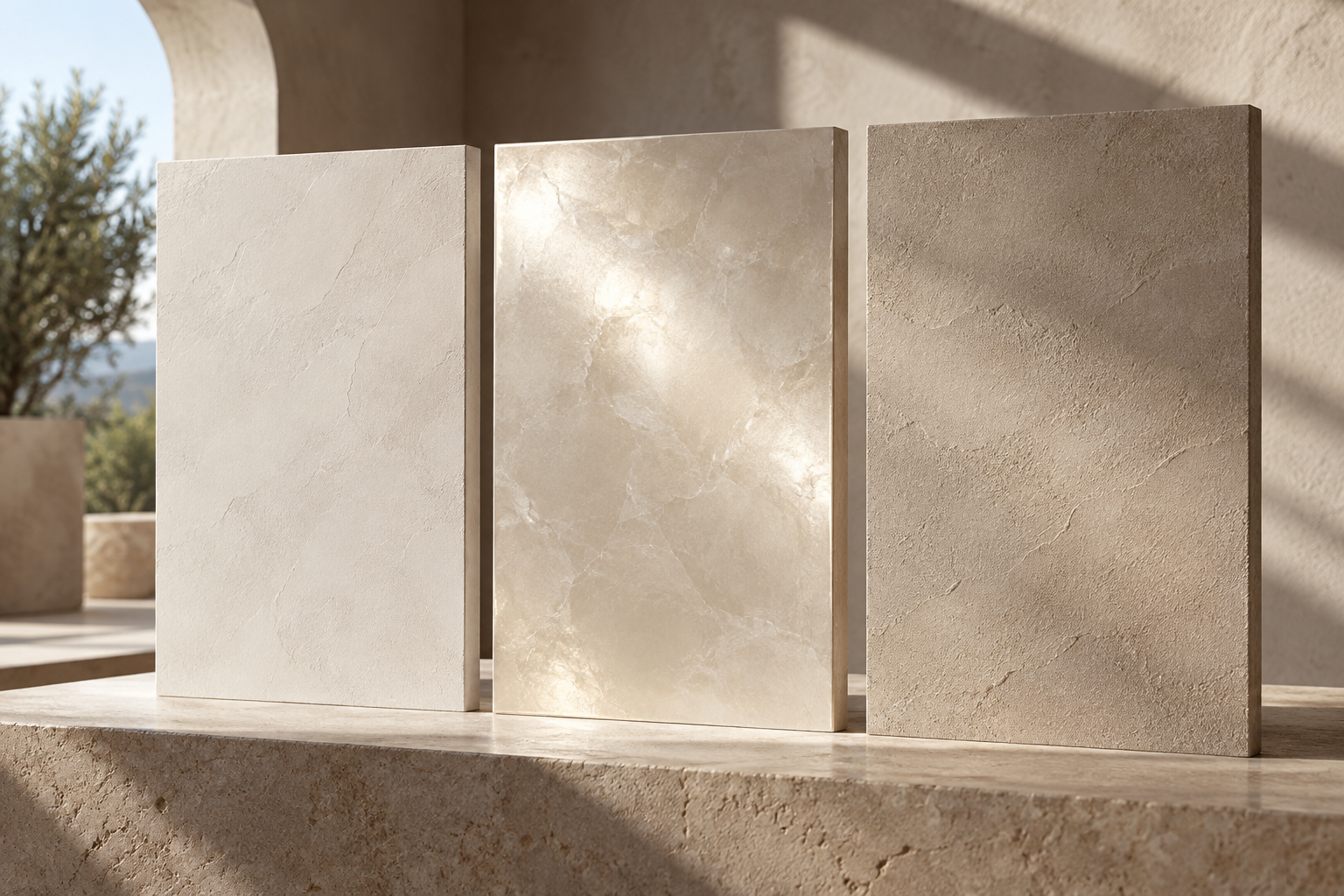
Venetian plaster, Marmorino and Roman Clay are frequently grouped together because all three are trowel-applied finishes with more depth than ordinary paint. They are not interchangeable. Their material composition, aggregate, layering and degree of compression create different surfaces—and different expectations for preparation, budget and care.
Venetian plaster
Venetian plaster is a broad modern term for decorative lime-and-marble plaster inspired by Italian traditions. Fine formulations can be built in multiple thin layers and compressed or burnished until light appears to move through the surface. Depending on the product and technique, the result may range from softly honed to highly polished.
The signature quality is luminosity. It does not look like glossy paint laid on top of a wall; the depth comes from translucent layers and reflected light within the plaster. Highly polished work demands exceptionally smooth preparation because sheen reveals every imperfection.
Marmorino
Marmorino is a lime plaster family that generally contains a more visible marble aggregate than ultra-fine polished plaster. It can be matte, honed or gently polished, often with a more mineral, stone-like body. Some versions show open movement and subtle aggregate; others can be compressed to a refined satin surface.
For many contemporary interiors, Marmorino offers a useful middle ground: more substance and old-world mineral character than Roman Clay, but less mirror-like polish than the most reflective Venetian finishes. Product names vary, so samples—not labels—should establish the desired texture and sheen.
Roman Clay
Roman Clay is a contemporary decorative coating designed to produce a smooth, matte, softly mottled surface. Depending on the manufacturer, it may be clay-based, gypsum-based, mineral or proprietary. It is normally applied in thin overlapping passes and can be sanded or compressed, but it does not usually achieve the same translucent mineral depth as layered lime-and-marble plaster.
Roman Clay is often selected when the room needs restraint: the quiet presence of handwork without a visibly polished statement. It is typically more accessible in labor and cost than authentic multi-layer Venetian plaster.
Which finish belongs where?
Choose Venetian plaster when luminosity, refinement and reflected light are central to the design. Choose Marmorino when you want the body of stone, visible mineral character and a honed or matte surface. Choose Roman Clay when the goal is a contemporary suede-like wall with subtle movement and less sheen.
Fireplaces, entry halls, dining rooms and sculptural walls can support greater polish. Bedrooms and broad living spaces often benefit from quieter Marmorino or Roman Clay. Bathrooms require product-specific decisions about waterproofing, sealing and direct water exposure; no decorative label automatically makes a shower system.
Preparation and budget
All three reveal the substrate, but polished plaster is the least forgiving. Wall flatness, corner quality, crack control and primer compatibility shape the result. Cost rises with preparation, number of layers, height, access, color depth and the degree of polish. A representative sample made with the full coating and protective system is essential.
Read our guides to Venetian plaster cost and wall preparation, or explore the complete Venetian Plaster pillar page.