
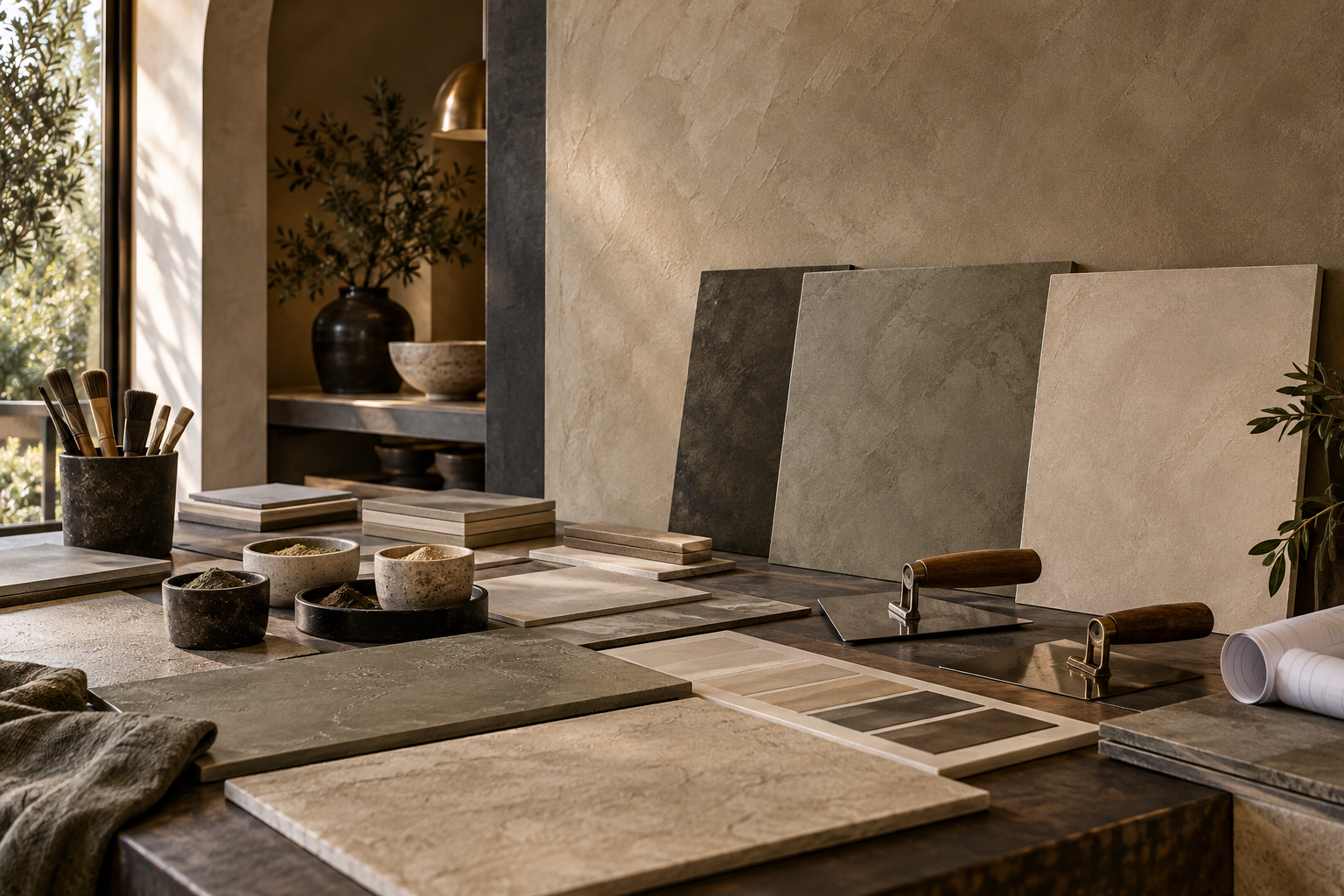
Roman Clay is priced as an artisan finish, not as ordinary wall paint. The material is only one part of the project. Wall preparation, samples, hand application, edge control, sanding, protection and the desired level of movement can matter more than the price of the bucket.
For early planning, professionally installed Roman Clay commonly belongs in a broad range of approximately $8 to $18 per square foot. Straightforward large walls with a ready substrate may fall toward the lower end. complex preparation, small rooms, tall walls, multiple colors or refined detailing can push a project higher. This is a planning range, not a project quotation.
Why online Roman Clay prices vary so widely
Some online figures describe material-only DIY cost. Others include professional installation but exclude skim coating, scaffolding, protection or sealer. A price for one uninterrupted wall cannot be compared directly with a stairwell, fireplace or powder room containing many edges and fixtures.
The only useful comparison is a clearly defined scope with the same substrate condition, finish standard and exclusions.
1. Existing wall condition
Roman Clay is applied in thin layers and does not conceal poor drywall. Heavy orange-peel texture, ridges, bad patches, visible joints, cracked corners and inconsistent porosity may require skim coating and extensive sanding before decorative work begins.
A smooth, sound and properly primed wall is less expensive than a wall that must first be rebuilt visually. On new construction, a coordinated Level 5 or equivalent smooth finish can reduce corrective preparation later.
2. Size and geometry
Large uninterrupted walls allow an applicator to maintain rhythm and use time efficiently. Small powder rooms may contain fewer square feet but more corners, fixtures, mirrors, transitions and protection per foot. Curves, soffits, niches, reveals, arches and integrated hoods also increase detail time.
Minimum project charges are common because setup, sampling, mobilization and cleanup exist even when the decorative area is small.
3. Height and access
Two-story walls, stairwells and ceilings require staging, lifts or specialized ladders. Access slows production and increases protection requirements. It may also determine how many applicators are needed to maintain a continuous wet edge across the surface.
4. Color and movement
Light colors often require exceptionally clean tools and may benefit from non-marking trowels to prevent gray burnish lines. Dark colors typically show more movement and can reveal lap patterns or edge differences if the application is inconsistent.
A restrained, nearly monolithic finish and an expressive, highly varied finish require different sample development and technique. The approved sample should define the visual target before the price is finalized.
5. Number of coats and product system
Many Roman and Moroccan Clay systems use two decorative coats, but coverage and build vary by manufacturer, surface and application style. The quote should identify the primer, decorative material, number of coats and optional protective treatment rather than using “Roman Clay” as an undefined line item.
6. Sealer or wax
Protective treatments add material and labor. They may also alter the color and sheen, requiring another approval step. A sealer can improve wipeability, but it does not necessarily make the finish waterproof or stain-proof.
High-traffic halls, kitchens and some bathroom walls often justify protection. Bedrooms and low-touch feature walls may be left natural when the manufacturer permits it.
7. Samples and design coordination
Professional samples are part of the specification. They determine color, movement, tool marks, sanding and sheen. Large-format samples viewed in the room are more reliable than small chips or phone photographs.
Projects involving custom colors, multiple rounds of approval or designer coordination should carry that time explicitly rather than hiding it in the installation rate.
Roman Clay material cost versus installed cost
Material coverage varies. Meoded lists approximately 120–140 square feet per gallon for two coats of Moroccan Clay, while other systems are sold by weight and publish different coverage rates. Material calculations must include primer, waste, tinting, protection and sealer—not only the finish coat.
Labor remains the larger variable because the work is performed by hand across the entire surface.
How to compare bids
Ask whether the proposal includes wall correction, primer, samples, all finish coats, sanding, sealer, protection, access equipment, touch-up expectations and final cleanup. Confirm whether square footage is measured as wall area or floor area. Clarify who is responsible for drywall quality and trade damage.
The lowest square-foot number may exclude the very preparation that determines whether the finish succeeds.
Is Roman Clay worth the investment?
Roman Clay makes sense when the wall is part of the architecture rather than a background color alone. It creates depth without the visual weight of stone or the gloss of polished plaster. Used selectively on major planes, fireplaces, entries or primary rooms, it can deliver more impact than spreading a decorative budget thinly across every surface.
Read how Roman Clay walls are prepared and applied, compare it with other mineral finishes, or explore our Roman Clay services.