
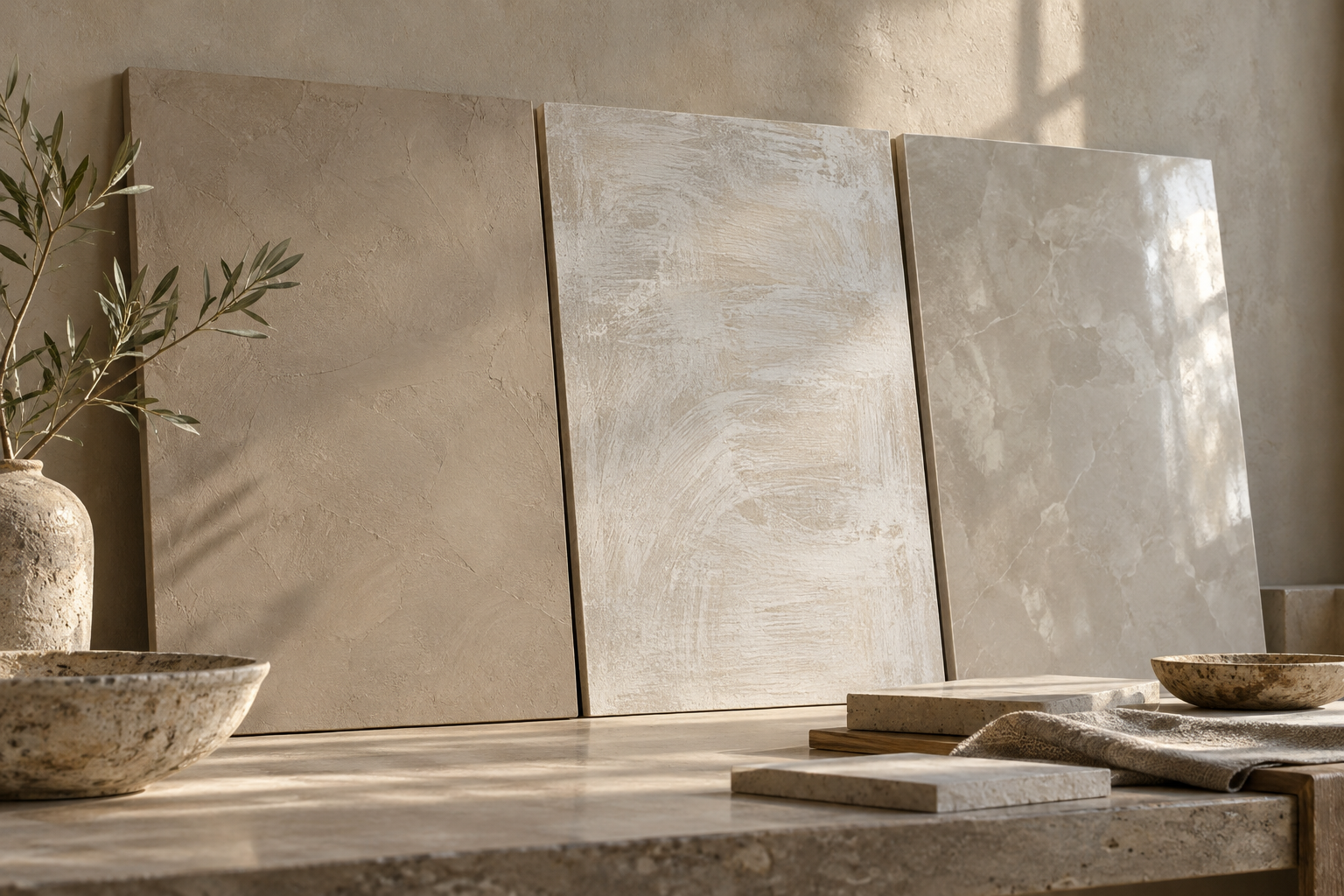
Roman Clay, Venetian plaster and limewash are often grouped together because all three create walls with movement and depth. But they are not interchangeable. They use different application methods, respond differently to light and touch, and carry different requirements for preparation, protection and maintenance.
The right choice begins with the room and the performance expected from the surface—not with a single inspiration photograph.
The short answer
Choose Roman Clay when you want a smooth, matte, stone-like wall with quiet trowel movement. Choose limewash when you want a brushed, atmospheric finish with more visible clouding and a soft mineral character. Choose Venetian plaster when you want greater depth, compression and the option of a satin or polished stone-like surface.
Each category contains multiple products, so the selected manufacturer’s technical system remains the final authority.
What is Roman Clay?
Roman Clay is a contemporary decorative coating applied in thin overlapping passes with a putty knife or trowel. The result is typically smooth to the touch, ultra-matte or low-sheen, and softly variegated. It can resemble worn limestone, honed stone or restrained plaster without the optical gloss associated with polished Venetian work.
The name is not a regulated material standard. Some products are clay-based; others use gypsum, mineral fillers or proprietary binders. Portola describes its Roman Clay as a paint-and-plaster hybrid for smooth interior walls. That is why we specify a complete manufacturer system rather than assuming all products behave identically.
What is Venetian plaster?
Venetian plaster is a broad family of lime-based decorative plasters, often incorporating finely ground marble. Multiple thin coats are compressed and refined by hand. Depending on the product and technique, the finish may be quietly matte, satin, highly burnished or nearly reflective.
Compared with Roman Clay, Venetian plaster generally offers more optical depth and a harder, more stone-like character. It also asks more of the applicator. Timing, pressure, trowel control and edge management strongly influence the result.
What is limewash?
Limewash is a thin mineral coating traditionally made from lime putty and water, often tinted with mineral pigments. It is brushed rather than troweled. The wall’s absorption, the brushwork and the overlap between coats create its recognizable tonal variation.
Limewash usually reads as softer and more atmospheric than Roman Clay. Roman Clay creates a denser plane; limewash allows more of the wall’s mineral character and brush movement to remain visible.
Texture and movement
Roman Clay is generally the quietest of the three from across a room. Its movement is revealed by changing light and close viewing. Limewash shows broader tonal clouding and brush variation. Venetian plaster can range from subtle marmorino-like depth to dramatic polished movement.
None should be judged from a small digital image alone. A representative sample should be viewed vertically, in the intended lighting, beside the flooring, millwork, stone and textiles.
Sheen and color
Roman Clay is naturally matte, though sanding, compression and protective topcoats can increase sheen. Light colors tend to show gentler movement; darker colors often reveal stronger trowel variation. Some sealers deepen the color and shift the finish toward an eggshell appearance.
Limewash remains chalky and light-absorbing. Venetian plaster provides the broadest sheen range because it can be left matte or burnished to a luminous polish.
Durability and cleaning
A sealed Roman Clay surface can be more wipeable than an unsealed one, but a topcoat does not automatically make it waterproof or stain-proof. In high-traffic areas, the product and sealer should be approved together on the sample.
Limewash ages with patina and can often be refreshed with compatible coats. Venetian plaster can be durable and hard when correctly installed, but repairs to highly refined work may require reworking a larger plane so the movement remains continuous.
Bathrooms and wet areas
Standard Roman Clay is appropriate for powder rooms and selected bathroom walls outside direct water exposure. It should not be treated as a shower waterproofing system. Limewash also requires careful product-specific evaluation in damp rooms. For direct shower exposure, a purpose-built system such as traditional tadelakt or sealed microcement may be more appropriate over a correctly waterproofed assembly.
Cost and preparation
Limewash is often the least labor-intensive when the substrate is compatible and ready. Roman Clay sits in the middle: it requires a smooth surface, specialized primer, samples and troweled coats. Venetian plaster generally carries the highest labor and skill burden, especially when the specification calls for multiple layers, burnishing or polished detail.
Preparation can change that order. Heavy texture, damaged drywall, high ceilings, tight edges or complex forms may cost more than the decorative material itself.
Which finish belongs in your room?
Roman Clay is especially effective in living rooms, bedrooms, ceilings, stair walls, fireplaces and architectural volumes where the design needs quiet depth. Limewash suits rooms that benefit from soft movement and a breathable mineral expression. Venetian plaster belongs where the architecture can support greater luminosity, refinement or drama.
Explore our complete Roman and Moroccan Clay guide, learn what drives Roman Clay cost, or read where Roman Clay belongs in a bathroom.
Technical references
Product behavior referenced here is grounded in current manufacturer guidance from Portola Paints and Meoded. Always confirm the current data sheet for the exact system being installed.