
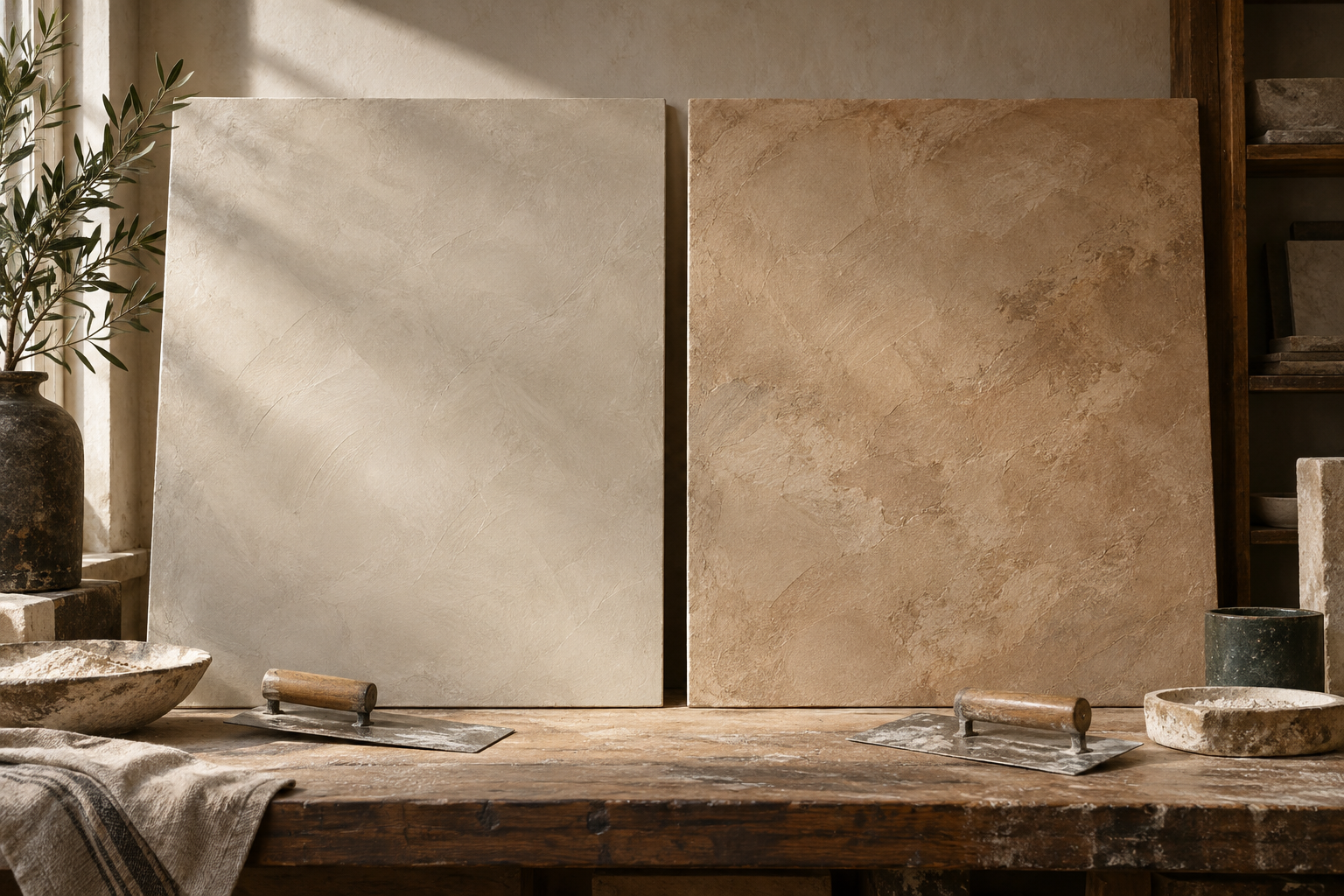
Roman Clay and Moroccan Clay often occupy the same visual territory: matte, hand-troweled walls with soft movement and a stone-like or earth-like presence. That similarity can make the names sound interchangeable. They are not.
Neither term functions as a universal building-material standard. The product name, ingredients, primer, coverage, sealer and approved applications must be read together. A claim that applies to one manufacturer’s system should not be transferred automatically to another.
What is Roman Clay?
Roman Clay is a contemporary decorative finish for smooth interior walls. It is commonly applied in thin overlapping layers with a trowel or putty knife. Portola describes its product as a clay-based paint-and-plaster hybrid with a subtle marble-like effect and ultra-low sheen.
Other products marketed under similar language may use gypsum, clay, mineral fillers or proprietary binders. “Roman” describes the aesthetic category more reliably than it describes one historic Roman formula.
What is Moroccan Clay?
Moroccan Clay is also used as a contemporary product name for a matte troweled finish. Meoded describes its current Moroccan Clay as a real-clay and mineral plaster designed for smooth interior drywall, plaster and prepared masonry. It is applied in thin coats and can remain natural or receive a protective treatment.
The name should not be confused with traditional Moroccan tadelakt. Tadelakt is a lime plaster compressed and treated with soap for water resistance. Moroccan Clay is generally a decorative interior wall finish, not a shower system.
Composition: compare the actual product
The most important difference may exist between manufacturers rather than between the two marketing categories. Meoded distinguishes its Moroccan Clay from gypsum-reliant Roman Clay products. Portola describes its Roman Clay as clay based and made from natural ingredients. Those statements demonstrate why blanket definitions can be misleading.
For specification, request the technical data sheet and safety data sheet. Confirm the binder, VOC information, substrate requirements and compatible protective treatments for the exact product.
Appearance and texture
Both finishes can create a smooth, low-sheen surface with overlapping trowel movement. Roman Clay is often specified for a controlled, quiet stone effect. Moroccan Clay may be selected for a slightly earthier material story and soft mineral texture, though technique can make either system more or less expressive.
The applicator has significant influence. Trowel size, pressure, direction, sanding and color can produce greater visual difference than the product name alone.
Color and sheen
Light colors generally show softer movement and demand clean or non-marking tools. Darker colors tend to reveal more compression and variation. Both categories may be left matte or protected with a compatible topcoat or wax.
Protection changes appearance. Portola notes that its Roman Clay Topcoat can darken color and add an eggshell-like sheen. Meoded lists penetrating sealer and Hydrowax options with different effects. Always approve the complete system on a sample.
Breathability and environmental claims
Clay and mineral finishes are often marketed as breathable, natural, low-VOC or humidity-regulating. Those claims can be meaningful, but they belong to a specific formulation and test basis. Adding acrylic primer or a protective topcoat may change the behavior of the complete assembly.
We do not promise universal breathability from a category name. We verify the manufacturer’s current documents and specify the wall as a system.
Surface preparation
Both finishes favor a smooth, stable substrate. They will not hide significant texture, cracks or poor patching. New drywall may need PVA primer and a specialty quartz primer. Existing glossy paint may require sanding and a bonding primer. Product-specific preparation controls.
Application and coverage
Two thin troweled coats are common. Meoded currently lists approximately 120–140 square feet per gallon for two coats of Moroccan Clay, depending on porosity and technique. Roman Clay products may be sold by weight and use different coverage calculations.
Coverage numbers are planning tools, not substitutes for sampling. A highly textured application consumes more material than a tight, smooth finish.
Sealing and maintenance
In low-touch rooms, some systems can remain unsealed to preserve their natural matte character. High-traffic halls, kitchens and selected bathroom walls may benefit from compatible protection. Use soft cleaning methods and avoid abrasives.
Neither a sealer nor the word “Moroccan” makes a decorative clay finish waterproof. Direct water areas require an approved wet-area system.
Which should you choose?
Choose based on the sample, the technical system and the installer’s familiarity—not the romance of the name. Compare composition, local availability, custom color options, primer requirements, coverage, protective treatments and the final visual character.
For a client who values the most natural clay-based formulation, a verified Moroccan Clay product may be compelling. For a project seeking a highly controlled, smooth, stone-like finish with a broad established color program, a Roman Clay system may be the stronger fit. Either can succeed when the specification is honest and the substrate is ready.
Read our preparation and application guide, learn where clay finishes belong in bathrooms, or explore our Roman and Moroccan Clay services.
Technical references
Current product information: Portola Roman Clay and Meoded Moroccan Clay. Specifications may change; confirm documents at the time of installation.